This post will detail the events of the first lecture of Professional Practice: Production & Development.
During the lecture, we were randomly assigned to groups of three. We were then given a piece of paper and told to fold it into four, in the four corners we wrote design, presentation, revision, presentation. In the first section, I wrote key things said during the lecture that I would base my design around. During this time, we worked individually, creating our own paper airplanes. On the back of this paper I drew plans for the first iteration of the paper airplane. It was a very basic and uninspired design. It was extremely wide and tall, when thrown it nosedived down to the floor. After throwing the airplane, and seeing it crash, I wrote down the events and believed cause in the presentation section so that, during the revision phase, I would be able to refer to them and design the plane to make up for the flaws.
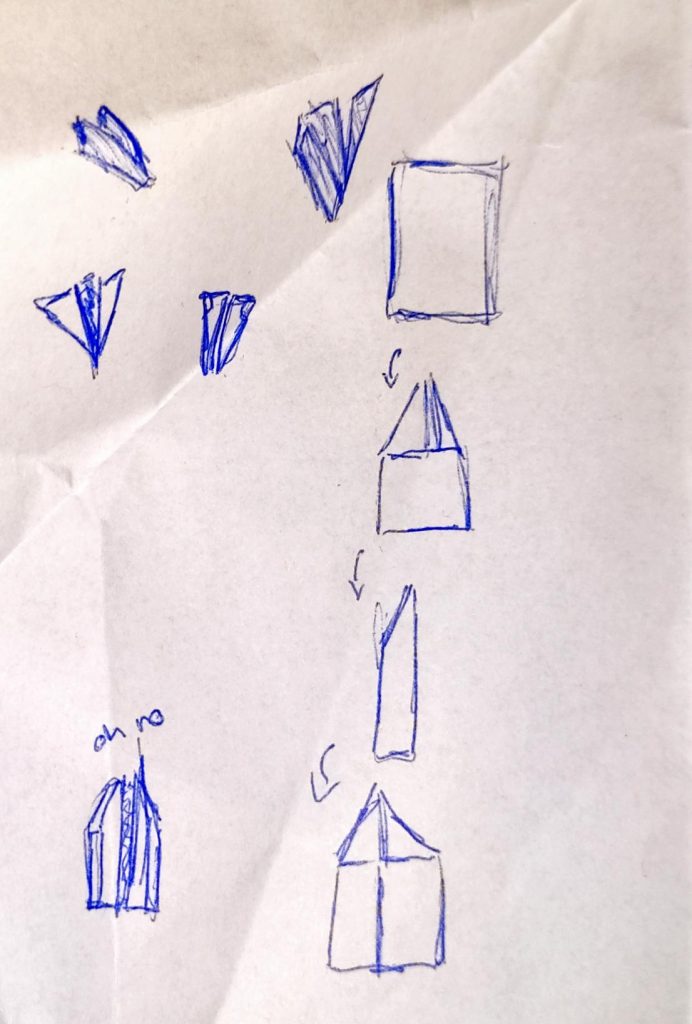
These are the plans that I made for the first paper airplane. They didn’t work. 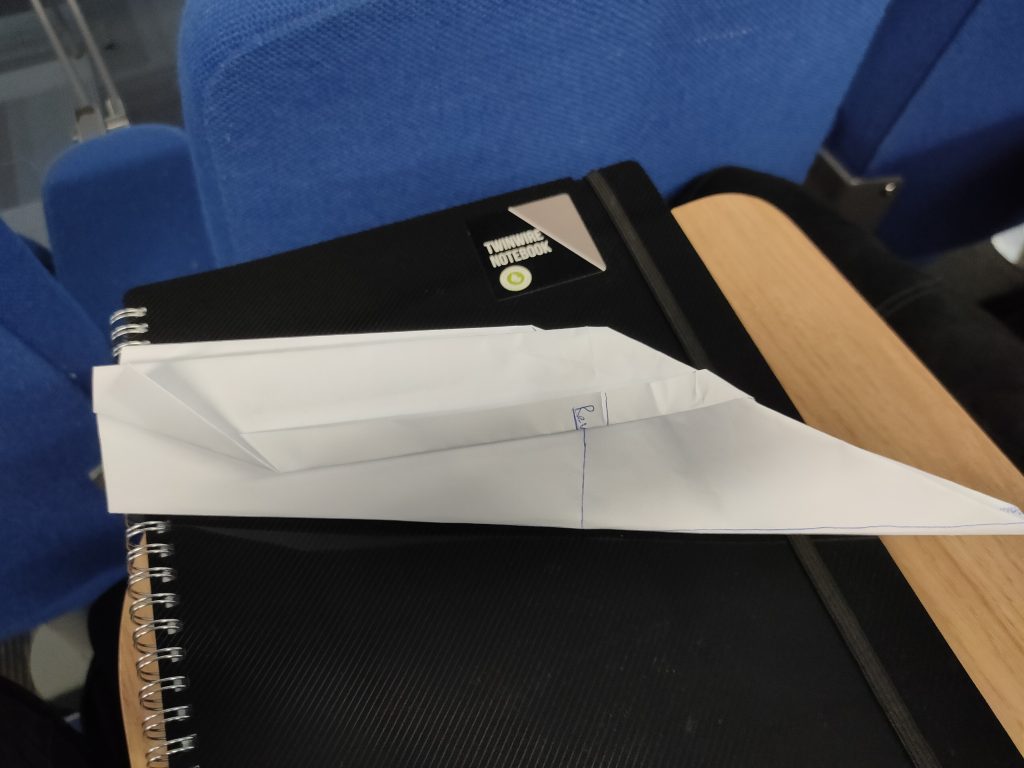
The first paper airplane I made during the session. It was very simple and failed.
To design the second plane, I looked online and found a design by the BBC (2014) said to be the perfect paper airplane. I presented this to my teammates and asked if they thought we should use it, they agreed and I was given the role of folding the plane. This design was far shorter than my design as well as far more compact. Although this was an overall solid build for the plane, it didn’t go very far. When thrown it veered left extremely hard and hit a wall.
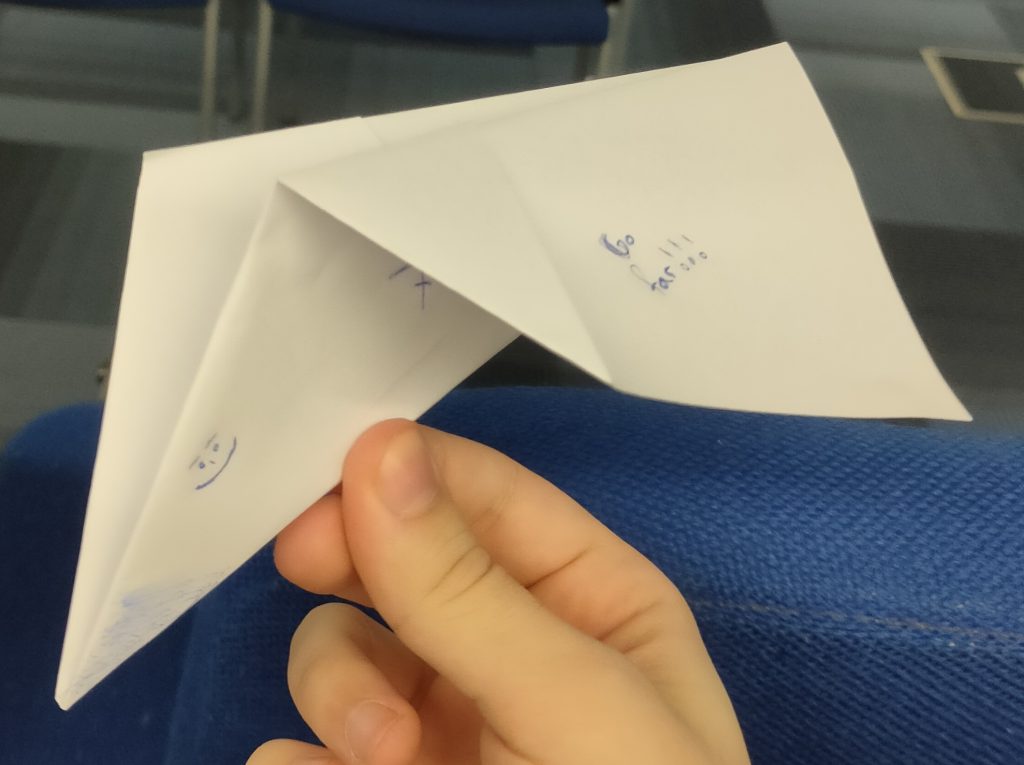
This is the second iteration of the paper airplane. We followed a tutorial by the BBC on how to make a “Perfect paper airplane”. The paper airplane was not perfect.
Overall, during this session, I learned about design and revision. This made me realize that the first design won’t ever be the most effective and that I must find the flaws in the first to stomp them out in the second.
BBC (2014) Guide: How to make perfect paper plane. [Available online: https://www.bbc.co.uk/newsround/26050831] [Site visited: 04/02/2022]