Pontefract is a market town located in West Yorkshire England. Fawcett (1921) noted that, during the English Civil War, the town was a dominating military position that had no rival as a fortress site.
Though the town has been known as Pontefract for centuries now, that was not the town’s original name. As stated by Leslie (1920) the town of Kirkby was located near a bridge, know in the local language as ‘Broken Bridge’. Though later, “The town came to be known as ‘Pontefract,’ when the French language was gaining ground, due to the presence of Normans in England” (Leslie, 1928)
After William The Conqueror was crowned king, “Ilbert I and Walter De Lacy, brothers, came to England from Normandy” (Patterson, 1968). Due to being a close follower of William during his invasion of England Ilbert De Lacy was granted land within England, therefore “Ilbert’s estates became the Honor of Pontefract.” (Patterson, 1968). Taylor (1819) states that the current structure was found by Ilbert De Lacy ten years after William’s conquest of England, “it was twelve years in building, and was finished in 1080” (Taylor, 1819).
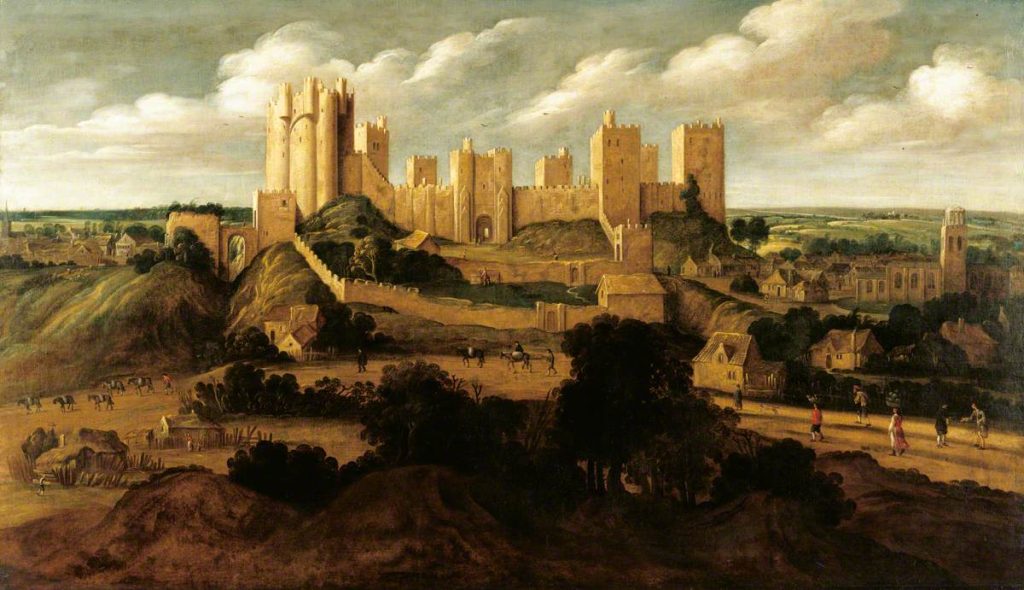
Keirincx, A. (1639-1640) Pontefract Castle [Painting] Pontefract Museum, Pontefract. Available online: http://www.artuk.org/artworks/pontefract-castle-22557 [Accessed 07/11/2022]
Pontefract Castle is also supposedly the location in which Richard II died. “Richard II, is a striking instance, who certainly met his fate in Pontefract Castle.” (Taylor, 1819). Although it is generally agreed upon that Richard II died within the castle, it is not know for certain how he came to die. Taylor (1819) states that starvation is the most likely cause, though, although unlikely, combat could have been the cause also. This is mentioned in William Shakespeare’s play King Richard III (1592-1594), “To-morrow are let blood at Pomfret Castle” (King Richard III, 3.1.183).
During the English Civil War (1642-1651), a war fought between Royalists and Parliamentarians “over longstanding disputes about religious freedom and how the “three kingdoms” of England, Scotland and Ireland should be governed.” (Onion, Sullivan & Mullen, 2010), Pontefract Castle stood as a stronghold for Royalist forces, Leslie (1928) states “It was besieged, unsuccessfully, by Parliamentary forces…the siege being raised on 1 March , 1644/5.”. Although this siege failed, “It was resumed, however, in the same month and the Castle was surrendered by Royalists…on 20 July 1645”. Though the castle held strong for a long time, it was set for “demolition in 1649 at the close of the civil war” (Fawcett, 1921)
Though the castle was sieged and ultimately demolished at the end of the civil war, the grounds and remnants of the, once great, structure are open to the public for viewing. “Pontefract Castle is open every day and entrance is free.” (Wakefield Council, 2022)
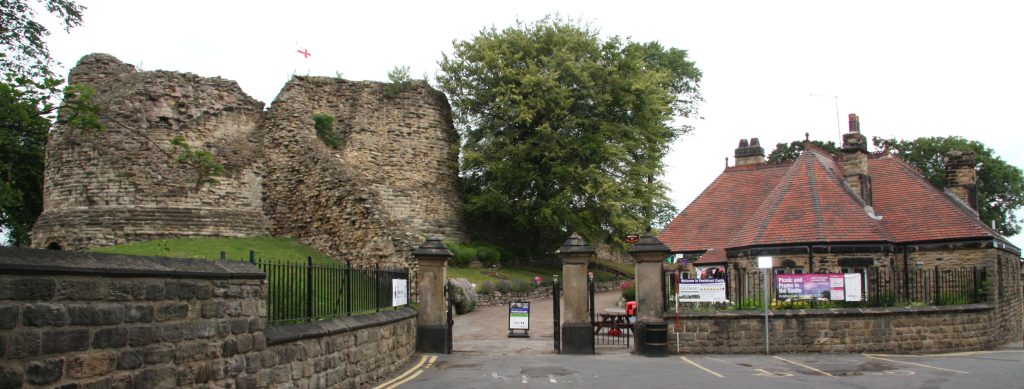
Grassam, A. (2015) Pontefract Castle: Excavations are Go! [Photograph]. Available online: https://www.wessexarch.co.uk/news/pontefract-castle-excavations-are-go [Accessed 07/11/2022]
Above and below are images of Pontefract castle in 2015, open for the public to explore.
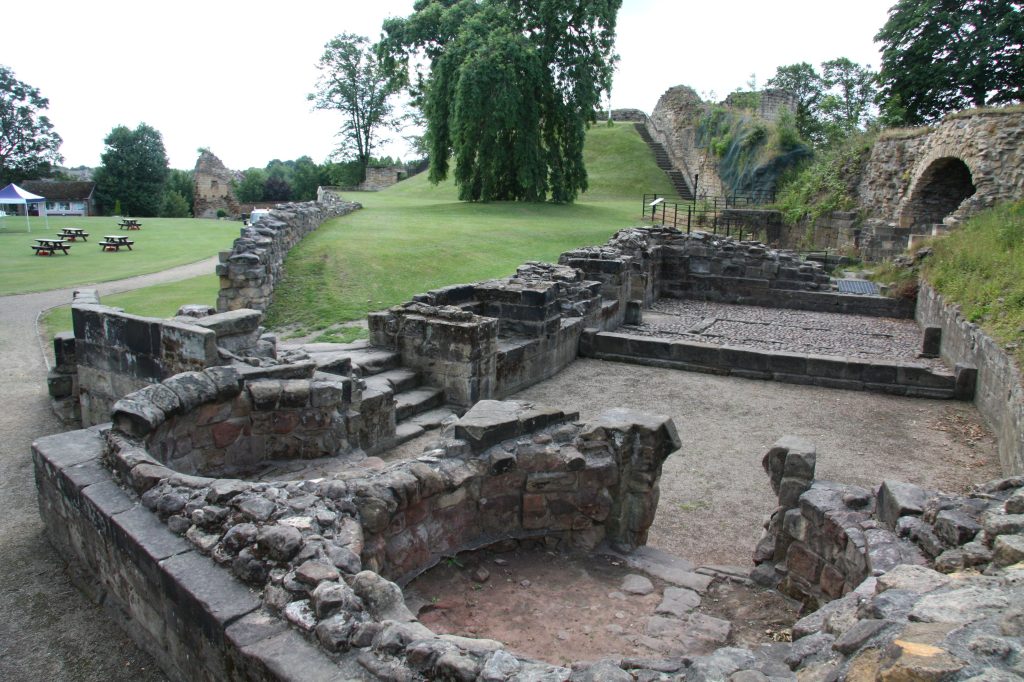
Grassam, A. (2015) Pontefract Castle: Excavations are Go! [Photograph]. Available online: https://www.wessexarch.co.uk/news/pontefract-castle-excavations-are-go [Accessed 07/11/2022]
References:
Fawcett, C. B. (1921) Review of The Story of English Towns: Pontefract, by J. S. Fletcher. The Royal Geographical Society (With the Institute of British Geographers). Vol 58, No. 1, pp 59-61.
Grassam, A. (2015) Pontefract Castle: Excavations are Go! [Photograph]. Available online: https://www.wessexarch.co.uk/news/pontefract-castle-excavations-are-go [Accessed 07/11/2022]
Onion, A., Sullivan, M., Mullen, M. (2010) English Civil Wars [Webpage] Available online: https://www.history.com/topics/british-history/english-civil-wars [Accessed 16/11/2022]
King Richard III by William Shakespeare. 1633. Sadler’s Wells Theatre.
Leslie, J. H. (1928) I. Pontefract. Yorkshire-West Riding. Vol 7, No. 28. pp 123-124.
Patterson, R. B. (1968) Review of The Lacy Family in England and Normandy, 1066-1114, by W. E. Wightman. The University of Chicago Press. Vol 43, No. 1, pp 200-203.
Shakespeare, W. (1592-1594) William III. Available online: https://stageagent.com/shows/play/2357/richard-iii/script [Accessed 07/11/2022]
Taylor, C (1819) Review of History of the Ancient Borough of Pontefract, by Benjamin Boothroyd. The Literary Panorama, 1806-1819. Vol 4, pp 895-899.
Wakefield Council (2022) Pontefract Castle. [Webpage] Available online: https://www.wakefield.gov.uk/museums-and-castles/pontefract-castle? [Accessed 16/11/2022]